-

-

Sunday, May 27, 2012

Bee Proof


I have been a very frustrated beekeeper these last five months. Suddenly becoming deathly allergic to bee stings is such a blow to my plans. I dream of having lovely hives of honey bees everywhere I can nestle them.
Then one lovely June day last summer, I get stung on the cheek by an innocent honey bee being smashed by my glasses and off for an ambulance ride I go. And to add insult to injury, the ER doctor tells me my allergic reaction will only get worse the more times I am stung and sends me off to get my EpiPen (Epinephrine Auto-Injector) from the pharmacy. I barely remember the details of the incident, but I'll never forget the look on Bucks face when I woke up in the hospital.
I have now been stung two more times since the "Big Sting" and have managed not to die, but it is very stressful for everyone, especially Buck.

The other two times happened while I was mowing.  There is a lot of mowing to be done here, if we are ever going to reclaim this land from the invasive plants. And I am generally the one who is bound to mow. With bees and hornets everywhere, how do I even garden or mow, let alone keep bees? I could live my life in fear in a climate controlled highrise somewhere. No thanks.

 I am not one to let things get me down (at least, not for long). I've decided that if others can spend hundreds of dollars on formal evening attire that they will only wear once, I can certainly justify the purchase of my formal suit of choice, and I will wear it many more times.
 
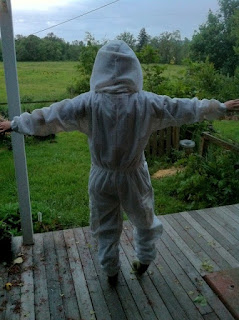
This is my new, virtually sting proof, Ultra Breeze bee suit. Designed by a bee keeper, it has 3 layers of breathable fabric. The "breathable" part is super important since I will be mowing in it. Mowing is a sweaty job and I don't want to collapse from heat stroke.
 
The middle layer is a thick spongy net that keeps the bees away from your skin, so their stinger can't reach through.

The hood also has a completely inclosed fastening system. As does the zippers on the legs. It's easy to put on and take off too, once you get the hang of it. It is so cool that I'm sure I will look cool to anyone who sees me mowing in this. Like mowing on the moon.
 
When Buck was taking these pictures, I laughed and remarked that the suit is probably not very flattering, and he said "It's very sexy, because now you won't get stung."

He says the sweetest things.


Afterthought: Of course my Ultrabreeze suit came the day after Hive #1 swarmed. Read how our son Jake saved the day on my bee blog.
I also posted a more recent review and caution in "How Bee Proof is Bee Proof?"

Thursday, May 17, 2012

Annual Chores

We have been on the homestead for a couple of years now, long enough to start to feel the cycles of projects that come around every year.  

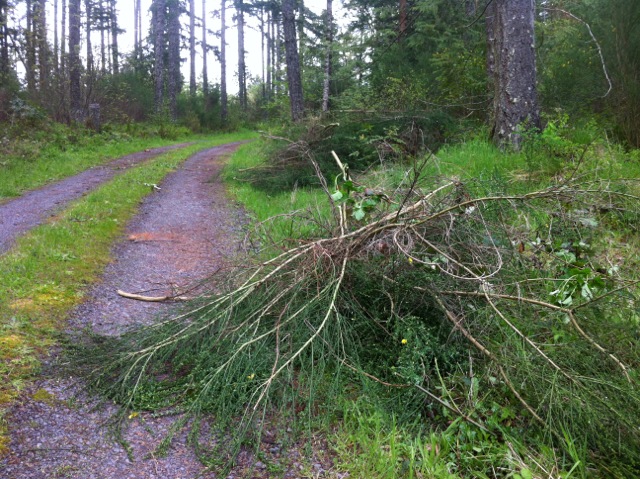
Every year, winter wind and snow bring down branches. We have a lot of Douglas Firs on the property. They are big and beautiful, and they loose branches pretty regularly.
They accumulate around the bottom of the trees. When I clean them up, the little limbs go into the burn pile, the rest make great firewood.
There are some old fruit trees around. This poor plum tree lost about half its limbs. I had to get the downed branches up off the ground so we could mow underneath, to keep the blackberries from growing up through it.
We will take another look at the tree when I get serious about fire wood. It is probably too damaged to keep, and is likely going to end up in the wood shed this fall.
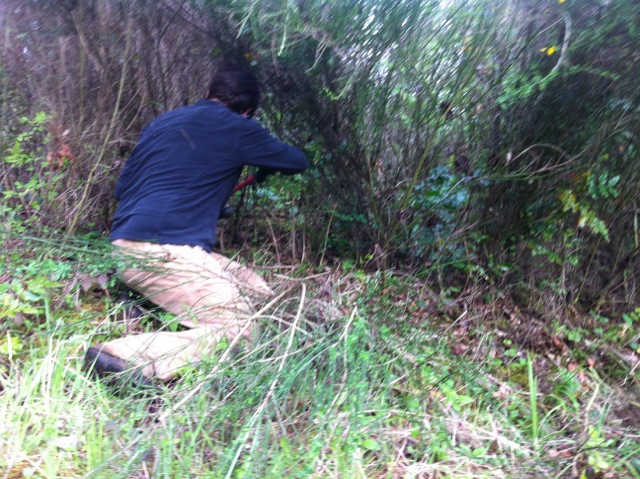
In addition to the blackberries, the other scourge we have to deal with is Scotch Broom. It is invasive and grows quickly and thickly in open areas.
Every spring Phoebe pushes it a little further from the edge of the driveway. She lops it off at ground level, and I take load after load away in the trailer. I think we filled the trailer 9 times this year. 
All these bits end up on the burn pile. It makes for a full day of burning.
And of course, there is the mowing. Phoebe already cut this field a couple of times, and I was feeling like I needed to take a turn. In the distance behind me are the yellow blooms of the Scotch Broom, and the green brambles of blackberries. We would love to get those cleared, but that is for another spring.
 
Another spring ritual is to take a look at the old cherry tree, to see how she is doing this year. The tree looks dead, and would have been cut down if Phoebe had not spotted a couple of new branches on one side. Every year, they get a little bigger, and right now, they look beautiful.
And there are always surprises. 
 
Phoebe and I were having our morning tea in the Oasis trailer, when she looked out the window and noticed the green roof on the loafing shed in the paddock.
 
It is a thick, and probably structurally unhealthy, carpet of growth on the gently sloping roof. I am not sure how many different kinds of vegetation are up there, but it sure looks pretty.
As always, we enjoy hearing from you. Do you have any spring chores that you look forward to or want to run away from?

Monday, May 14, 2012

Colony Collapse

Please go on over to my bee blog Homesteader Bees to read the sad fate of Hive #2.

Saturday, May 5, 2012

Out with the Old and In With the... Um, Old

I have been working on the Art Shack and the Oasis in between repeated mowings and Scotch broom whacking this spring and it's really coming along. Soon I will be jealous of our guests as they while away the hours in their own tiny heaven on top of the hill.
The Oasis is in need of a lot of cleaning because, besides the fact that it sat unloved for a couple of years with a hole in its roof,


 it was also an "Elk Camp" trailer for years before that. And if you don't know what that means I'll sum it up for you. Many adults with guns, beer, bacon and no constraints of social norms, like cleaning the kitchen when your done frying those pork chops or doing silly things like wiping your feet.


Nothing a little soap, bleach and Windex can't fix.


 Another thing that I find hilarious and maddening is the incredible amount of hardware that has been tapped, screwed and unceremoniously glued to the inside of this poor trailer. Every time I think I have pulled all the superfluous things out of the once magnificent insides I find another row of tiny nails (to hold wires?) or another hook (to hang what?).
 
I have an entire clock box full of this stuff and it keeps appearing before my eyes.

One of the little pet projects I have been cheering myself up with is stopping at thrift stores now and then and searching for just the right dishes and pans for a 1958 Oasis.
 
 Like this sweet little tea kettle (and the whistle still works).

The Folger's coffee can to hold matches (like my grandma had). I also found the light globe at the Habitat for Humanity "ReStore" for .75 cents (SCORE).
 

Some things did have to be replaced with the new.
For instance, I draw the line at cutting my food on this fine, original cutting board.
So into the back closet it goes, in case someone cares later about "original parts".

 I bought this bamboo cutting board at Grocery Outlet for $8.


I ran it through the table saw and used the trimmings to make a stop on the bottom.

 
Now we can have PBJ sandwiches without the Formica flakes.

And now,  I GIVE YOU (drum roll, please) THE (slightly politically incorrect as only things from the 50's and 60's can be) TRAVEL PLATES!


O.K. this is more of a grandma plate but I couldn't resist it.


And the most outrageous of the bunch, (I must apologize to any Pennsylvanians) the Pennsylvania Dutch plate.
You have to admit this is pretty funny and awful. It's good to look back at our ancestors and what they thought was perfectly O.K. to make fun of. It gives us perspective.

Sunday, April 22, 2012

Grass

I told Phoebe I could do a post in just 6 words but I think I can do it in 4. Here goes:

The mowing. THE MOWING!
It is that special time of year in the NW when the grass grows 4-6 inches in a week. If you don't stay on it, you get buried by it. Between our two places, I imagine we mow a couple of acres.
At both places we use Snapper walk-behind mowers, the kind with rear wheel drive. We have had a few over the years, and have found them to be excellent mowers. 

Several times a year, we long for a tractor. But we are not yet ready to spend the money. There is a lot we could do with one, between the blackberries, brush, mowing and landscaping projects, but so far, the mowers are getting us through. Phoebe looks at it as her aerobic exercise.

A riding lawn mower sounds attractive some times too, but the ground is so rough I think it would be a miserable ride.
I used to be the primary mower, but that is no longer the case. At our town property, where these photos were taken, my father-in-law does most of it. I feel bad sometimes, having a man in his 80s do what used to be my mowing, but he sees it as a way to contribute. I really appreciate his effort, and I try to jump in when I can.

And at the Homestead, Phoebe has been doing almost all the mowing. I must say, it is really nice to show up and see the place looking neat and tidy.
I am curious about other parts of the country. How is the grass growing where you live? Is it crazy fast like here, or more moderate? Tractor, riding, push, or goats?
And do your apple trees look this pretty right now?

Monday, April 9, 2012

Mud Control

I am about to share a piece of information that will change your life. That is if your life is full of

 
MUD.

 And this little secret will turn
this 
to 
this

If you have any livestock at all, mud is a fact of life. Especially here in the Willamette Valley, where we are having a record setting spring for precipitation.

Horses can be the worst of offenders because of their weight, habits and their wide hooves which act like plungers on the soil.

Years ago a friend who ran a horse rescue gave us a tip which we have capitalized on for many wet winters. Rubber stall mats. The kind you would line horse trailer floors or cement floored stalls with.
Lay them right on the soil, BEFORE the mud begins.

If you lay them out after the mud gets deep, the mats will migrate and sink. Like this one did. They still keep the mud down but they don't work as well as they can if you put them down while it is still dry out.
The horses love to hang out in this corner where they can see the trailer, so they can see if we are coming to feed them on any given moment of the day. They like to dream that that could happen. The mat that has worked it's way up on top of the others only did that because we put it down after there was already some mud. If we had put it down while it was dry out it would have stayed put, like the other mats in the photo.
If you put them down while the soil is dry and flat, they will prevent the mud from forming in the first place, by spreading the weight of the animal over a wider area and causing rain to run off in another direction. They work amazingly well for years and years if they are put down while the soil is dry.

Stall mats are a bit expensive, around $35 on sale but they last forever and make you and your animals life so much better. They're mobile so you can take them elsewhere when you need to. Albeit a little like wrestling a giant stinky eel, if you have to move them in winter.

They are made of recycled tires and last forever. We have some that are 14 years old. They don't smell so great, but they do the job.

Buck and I invested a bit of money last fall on setting up our loafing shed and the accoutrement that go with having a sturdy and safe area for livestock. At the top of the list and worth every dime were several stall mats.
 
Strategic placement of the mats help make the most of what we've got. Inside the loafing shed they make a safe and sanitary place to toss hay. Make sure you do not let the edge of a mat hang out in the roof drip line though, because it will funnel water into your barn.

They also make it extremely easy to clean out the shed with a flat shovel. Then we just hose it off. It always helps if you have situated your shed and pasture on slightly higher ground, so that you have good drainage.
 
Most livestock want to pace the fence closest to the barn where the food comes from.

Gates are a funnel for increased foot traffic.
 

Water and food troughs are always a real vortex of mud too.

We are far from having a mud free pasture, but these mats make all of our lives a lot better all winter long and each summer we will add a few more.

 Here are a few of the websites I have found useful in my battle with mud.

Pennsylvania State University "Nutrient Management"
Sacrifice area.
Oregon State University Small Farm
Tips on Land and Water Management for Small Farm and Livestock owners