-

-

Saturday, July 24, 2010

The Nectar Flow Has Begun


A fresh comb from our hive which I have decided to call "The Women's Honey Cooperative"


They say that the sum total of the life's work of one average honey bee is 1/12 to 1/4 teaspoon of honey and that over 2 million flowers are visited to make one pound of honey. Thinking about this inspired me to look around the Homestead from a bees perspective. Looking at every plant blossom as a potential food source put a new twist on my flower viewing.

Shasta daisy


Rose


Foxglove


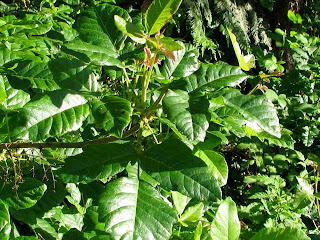
Poison oak

Native Columbine

Cilantro in the garden


I am told by beekeepers in Western Oregon that the nectar flow from which our bees make a majority of their yearly honey from is, ironically, the invasive and dreaded Himalayan Blackberry (Rubus armeniacus), so named by the famous hybridizer Luther Burbank.

Since it's introduction into the US by Mr. Burbank in 1885 it has invaded woodlands from Hawaii to Australia and continues to weave it's way into every nook and cranny of our acreage as the minutes tick by. It has the unfortunate knack for crowding out native plants, creating mono cultures on our forest floors and destabilizing river and creek banks and causing erosion.

Mr. Burbank, responsible for developing and introducing over 800 strains and varieties of plants, got it right with Burbank potatoes and Santa Rosa plums but he also, unwittingly, saddled the world with the Himalayan Blackberry.


Blackberry blossoms

Most of the time we curse it, chop and dig it and untangle it from our bleeding arms.

But then for a brief time in August we have a pleasant sort of amnesia about what a pest it is because there are luscious berries by the buckets full. Then there are blackberries on yogurt for breakfast, blackberries on ice cream and then blackberry pie and amazing blackberry jam if we are feeling industrious.

And now we have another reason to temper our disdain for the plant, our bees survival and the extra honey.

Our bees are well established now and have filled about 15 bars with comb. Most of those combs are filled with brood (different stages of baby bees), but now they are filling fresh white comb with blackberry nectar.


Our bees working away on the honey cells


They will fan the cells full of nectar with their wings until it evaporates to the proper water content for honey and then the cell will be capped as storage for food in the winter.


A peek inside our top bar hive

Now that the rainy spring has finally yielded to the hot sun, we are looking at the biggest blackberry blossoms I have seen in a long while. That made me happy for the bees. They'll be able to put a lot of honey away for this winter. Maybe even a little for us too. Perhaps I can feel a tiny bit better about how slowly the blackberry eradication project is going.


Here is a short movie of the bar I pulled from the hive this week. It has mostly open honey cells but the ones in the very top middle are capped. It also has a corner of comb from the next bar. I think I may not have the hive perfectly level. I'm sure the bees fixed the tear right away after I put the bar back.

Wednesday, July 21, 2010

Cherries and the First Egg


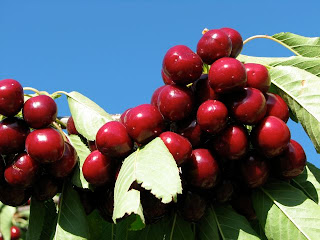
This week Buck and I went to Hood River on a whim and for the first time in years I was actually in time for CHERRIES! We went to a farm that was doing U-Pick. I made several jars of jam and syrup and 10 quart bags of pitted cherries for the freezer. 31 pounds of Bing cherries all set for pancakes, scones and hot oatmeal this winter.


Another exciting event this week is that the chickens laid their first egg. I hadn't realized they were old enough, but this morning I saw a hen doing the "come on, let us out! I need to lay an egg!!!" dance at the coop door. That's right , I have been around chickens so long I know that dance. This got me counting the weeks since our Cuckoo Marans were born. Sure enough they are (already?) 16 weeks old.


The egg was nice and large and a fairly dark brown. They are supposed to be very dark brown but I have found that often the chicks you get from the big hatcheries and feed stores do not always exhibit the traits you hope for. It all comes down to selecting in your future generations for the traits you want. When I had Ameraucanas, who lay all sorts of colored eggs, I selected for blue eggs by hatching only the blue eggs. We'll probably do the same for brown eggs this time. I love an excuse to hatch eggs.


I made the hens a little temporary laying box for now until we get the real hen house set up.

I like to sit and watch the chickens be chickens, which I find to be very simple and funny. Just for the fun of it here is a film of a few moments in the life of a chicken for you to watch.

Tuesday, July 13, 2010

Creatures We Have Seen


We have spent a lot of time out of doors here on the homestead, rain and shine, freezing (15F) and sweltering (98F). In that time we have only begun to catalog the amazing multitude of living beings we share this land with. I grew up here on the homestead and I have a lot of memories, but I did not have the perspective then, that I have now. In other words, I took it for granted.

In my years of gardening, landscaping and traveling I have come to realize how most of the modern world we live in is a narrowed down version of what the world of nature can and should be. It took a little time on the land for me to get back in tune and begin to notice the amazing diversity that we experience here at the homestead. Here are just a few of the creatures I have managed to catch with my camera. There have been many many more that were too fast or flitted by while I was not carrying my camera.


This is one of the many Pacific Fence Lizards that live in our garden. I make little "castles" for them with the rocks I dig up in the garden. Not a very romantic name but it fits since these guys love to hang out on fence posts. Although I don't really know if that is what they are named for.


A Tadpole peeks out from the water weeds.


What's that in the grass? A Blue-tailed Skink. Too quick for our camera. I'd never seen one before this.


Here is the trio of Pileated Woodpeckers that worked the dead tree limbs around the trailer all summer. It looked to me like they were a mated pair tutoring their single offspring on the fine dining of Termites.


This was a very mysterious siting for me. This fellow was ambling across the doorstep at dusk. I looked and looked in my Amphibian book but I could not perceive the differences or likenesses between the large amphibians in the book and this one. It was about 12" long! I did learn that many forest dwelling amphibians don't need a body of water to lay their eggs in, only a damp place, like a hollow log...


I think it might be a Pacific Giant Salamander. All the pictures show spots though and this guy (or gal) has none...


Snakes are special to me. I have always loved them since I was a child. I was thrilled to find this very large Pacific Garter Snake in my garden, staying warm for the night under an old tarp I had down in the garden to kill some grass. Snakes are very welcome in my gardens because they eat the dreaded SLUG.


Every day I see a bug I have never seen before or hear a bird song that I cannot place. It's a joy to just sit for a few moments and notice each layer of activity in the woods or the field. Every day there's something new.


Monday, July 5, 2010

Reluctance

So, why the Reluctant Homesteaders? Why not the Fortunate or Exuberant or the Happy Homesteaders?

As you may guess from reading these posts, it is not that we are reluctant about what we are doing. We are fully engaged, optimistic and enjoying the process.

For me the reluctance comes from what else is going on in our world. In addition to the 50 acres we are trying to rehabilitate at the Homestead, we have our other house. The one we lived in when this started, where we raised our kids and have Christmas, where we still live. It is on 1.3 acres, about 20 miles from the Homestead. We have been there for 11 years, and have found, over that time, that it is about as much as we can handle. With a stand of mature apple trees, espallier fruit trees, raspberries, blueberries, marionberries, grapes, a big vegetable garden, flower gardens and landscaping, it is more than enough to keep us fully occupied.

Here is an example. In the wash of green below, is a new raspberry patch I put in this spring.
(Click photo to enlarge.)
It is a little hard to see through the long grass. Once the grass was mowed and the weeds pulled, I got a chance to see how it was fairing.

Only about a 50% survival rate for the canes I transplanted. That is not what I was hoping for, and perhaps the neglect they suffered from my absence contributed to their poor showing. And the raspberries are only one of many projects Phoebe and I try to keep moving forward here, while taking care of the Homestead.

Of course, there is Work, that thing we do to finance all of this.

And then there is having fun, going out, riding our bikes, seeing people. Yeah, we try to do that too.

So, it is not a reluctance to do the work, or to be engaged in the project. In reality, I feel grateful for the opportunity to take care of both of these properties. And I feel a responsibility to the plants and animals that live on them, or eat from them or fly over them. And I find that as I help cultivate these lands, I am cultivating myself. Kind of like my raspberries, not all of the canes I put in the ground bear fruit, but the ones that do will be sweet.

Here are a couple more photos from our other house.
I planted a few canes of black raspberries, which are coming along nicely.

Grapes in their infancy.

Turkeys! Our first attempt at raising meat birds.


Friday, June 25, 2010

How The Garden Grows


Buck in our new berry patch. We only have to dig once!


Our second year garden at the Homestead

It's been a long cold lonely Winter and not much better of a Spring in Western Oregon. Summer? What's that?

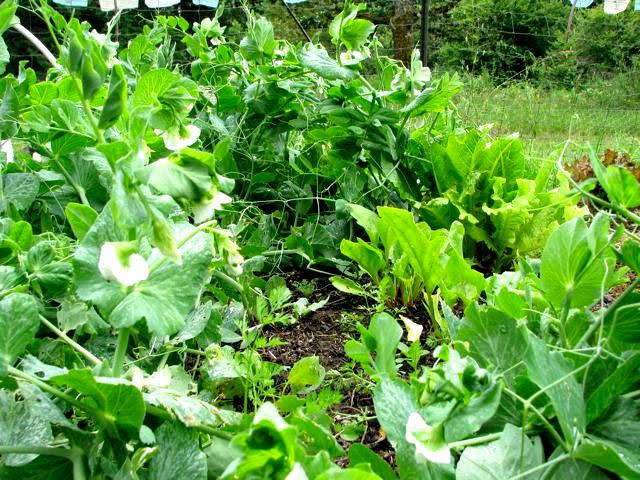
As a gardener, it's been a great lettuce and peas kind of summer. Only because I do raised bed gardening. Otherwise I'd be waiting with all the other gardeners 'till the end of June to rototill a mucky wet plot. There's no standing water on a raised bed.

If you see this book at a thrift store GRAB IT! It is out of print and is selling for $35 at Powell's. If you have to pay that for the book- it's worth every cent! But check your library first.


I have my Mom and Peter Chan to thank for starting me on the ancient technique of Mound Gardening. Peter Chan's book "Better Vegetable Gardens the Chinese Way" ( Garden Way Publishing) has been at the core of our gardening since Mom read it in 1977.

Mr. Chan, who worked at Portland State University at the time his book came out, taught Plant Pathology at an Agricultural College near Canton. He also worked in research on methods of adapting plants to various terrains, improving soil conditions and increasing plant yields., before he came to Portland Oregon with his family in 1967.

My Mom knew a good thing when she saw it. She was a brave woman. It's no small thing to throw all the trappings and dogma of generations of row croppers out and embrace this foreign way of doing things. While others looked on with scorn and criticism, I might add.

For her and then me, Mr. Chan's book has been a godsend on these years of the never ending wetness. No digging necessary! Just throw more mulch onto the beds in the fall to keep the spring weeds from forming. Then in the early spring ( we're talkin' March 1 or earlier) just make little holes and plant the peas and lettuce. Then when the lettuce begins to bolt and the peas have almost peaked, put in the rest of the garden just the same way.


Look at this yummy soil! Well, if you're a plant of course.


Poke a hole in the mulch and put your seed or plant in and cover it over. Water it in, think happy thoughts, done.


Some people are resistant to this approach. I can't figure it out. I suspect they think I'm lying! Or that I have a secret ingredient in the mix. But I swear it's that easy. Somewhere along the line someone managed to convince the public that growing food is very hard and beyond mere mortals and their lowly landholdings.


My two rows of lettuce in my Community Garden plot. After all the harvests so far!

The sheer amount of food I get from one 25x25 foot plot is mind boggling. This year I have harvested 6 grocery bags of baby lettuce from TWO 10 foot rows of lettuce (just thinning the rows). And we took an additional 15 mature heads to the food bank last Wednesday. I have that much more still to harvest this week from those same rows! Even while dealing with a perpetual multitude of baby slugs and hail storms in June.


What I love most; it is so low tech. Anyone with even the most meager of resources can do it. No lumber to buy (pressure treated lumber is expensive and dubious for organic gardening). No rototilling (who owns one, who fixes it, who pays, and how do we get it there?). The worms do all that work!

Have rocks in your soil? Just dig them up once and use them as decorations. And KEY to my love for this style of gardening is, plants thrive in the uncompressed, humus rich soil.

Every once in a while I revisit this fine book, as I did this spring, with Mr. Reynolds photographs of Mr. Chan's lovingly tended garden and I feel excited all over again. He makes it all so simple and, well, kind of sacred. Like your garden is a temple. And like a temple, you tread softly, tend thoughtfully and breath deeply. There are so many fewer worries in a raised-bed garden.

Another rainy day is forecast for July 1. Oh well. I have an impressive batch of baby carrots and potatoes coming in soon, the tomatoes are holding their own and I have enough lettuce and peas for anyone who wants them!

Thursday, June 24, 2010

Bee Day Is Here!


Here are the BaBees! 2 pounds 15 ounces!

After driving around with a full swarm-catching-kit in the back of my car for a couple weeks I got THE CALL to let me know the bees had swarmed. Not only had they swarmed, but the hive had sent out not one but two swarms! I think that is pretty unusual- twin swarms.

Buck and I got our light colored clothes on and high tailed it out the door. When we got there, Bee Mom and Bee Dad pointed out the swarms. One was in a Magnolia tree above the roof of their house and one was in a Conifer in the front yard.

We started with the Magnolia swarm because it looked the easiest AND the roofers were due any minute. You can see all of this captured on the beautiful video that Buck very deftly filmed and edited together.


The Conifer swarm was a little trickier. One limb needed to be cut to clear the area.
Nice Neighbor invented a fabulous "box on a stick" to catch the Conifer swarm. Bee Mom (wearing a full bee suit) stood at the top of a small step ladder while I steadied it. She held the box up high on the stick. Nice Neighbor shook the limb and voila, the second swarm came raining down- mostly into the box, but a lot fell out too. We closed the box and waited.... YES we got the Queen! Little bees were fanning their pheromones into the air at the entrance. They do that to let the other bees that are still flying around know that the Queen is inside the box.

We set the box in the shade nearby so the rest of the bees could find their way into the box.


It was a beautiful day and although both swarms were high off the ground we captured them both with only a little fuss and only one sting- Buck got it on the arm when a bee stung on impact from such a long and sudden fall out of the Conifer.

The whole experience was crazily wild in concept and oddly calming. Buck and I took home the Magnolia swarm and Bee Mom kept the Conifer swarm. She emailed me later and said that after we left yesterday afternoon, she got her car out of the shop, raced to the bee supply and bought a second hive. Upon her return, her husband assembled the hive while she and Nice Neighbor went and got paint.

She painted the new hive and then, since the cardboard box (built on the fly since she had only built ONE box in anticipation of ONE swarm), didn't look like it was going to hold out, she dumped the bees into their new home at 9PM last night. Whew. I felt like my day was pretty low key next to that.

When Buck and I got home it was pretty hot out and so I set the bee box in the middle of the living room and just kept squirting sugar syrup in the screened windows.
You could tell when they were done eating each serving because they would start humming super loud and would get quiet when I squirted more in. Three sneaky bees got out and I caught them in a glass jar and took them with the box.

When it cooled off outside we took the box-o-bees to the hive and I just winged putting them into the hive from what I had read in books and online. You'll see in the video "Rehiveing" that I whack the box a couple times before I unceremoniously dump them into the new hive. That's because you need to get them into a clump so most of them will land in the hive, increasing the chances that the Queen will land in the hive too.

Because, if the Queen is left in the box as a straggler and she up and flies away... sooolong swarm! All the bees will just pour right back out of the hive and fly off to follow their Queen.

But I got her in and she apparently approves, since the workers were happily buzzing in and out getting supplies for housekeeping this morning!

When I went to bed last night I kept hearing bees buzzing for some strange reason. It was as if their buzz had imprinted on my brain.

I had a hard time going to sleep.

The ReHiving

Here is part 2 of our big bee adventure.


Enjoy.